
Comparison
Manuka vs acacia honey — which to choose?
These two barely belong on the same shelf. Manuka is a dense, bitter, lab-certified medicinal honey you buy by the MGO number, around $38 a jar. Acacia is the mildest, palest honey there is, about $16, made to sweeten without flavor. For a sore throat, Manuka. For a drizzle, acacia, every time.

Honey · Medicinal honey
Manuka Honey (UMF)
North and South Island, coastal and forest scrubland, New Zealand (UMF)
cooked honey · eucalyptus · licorice
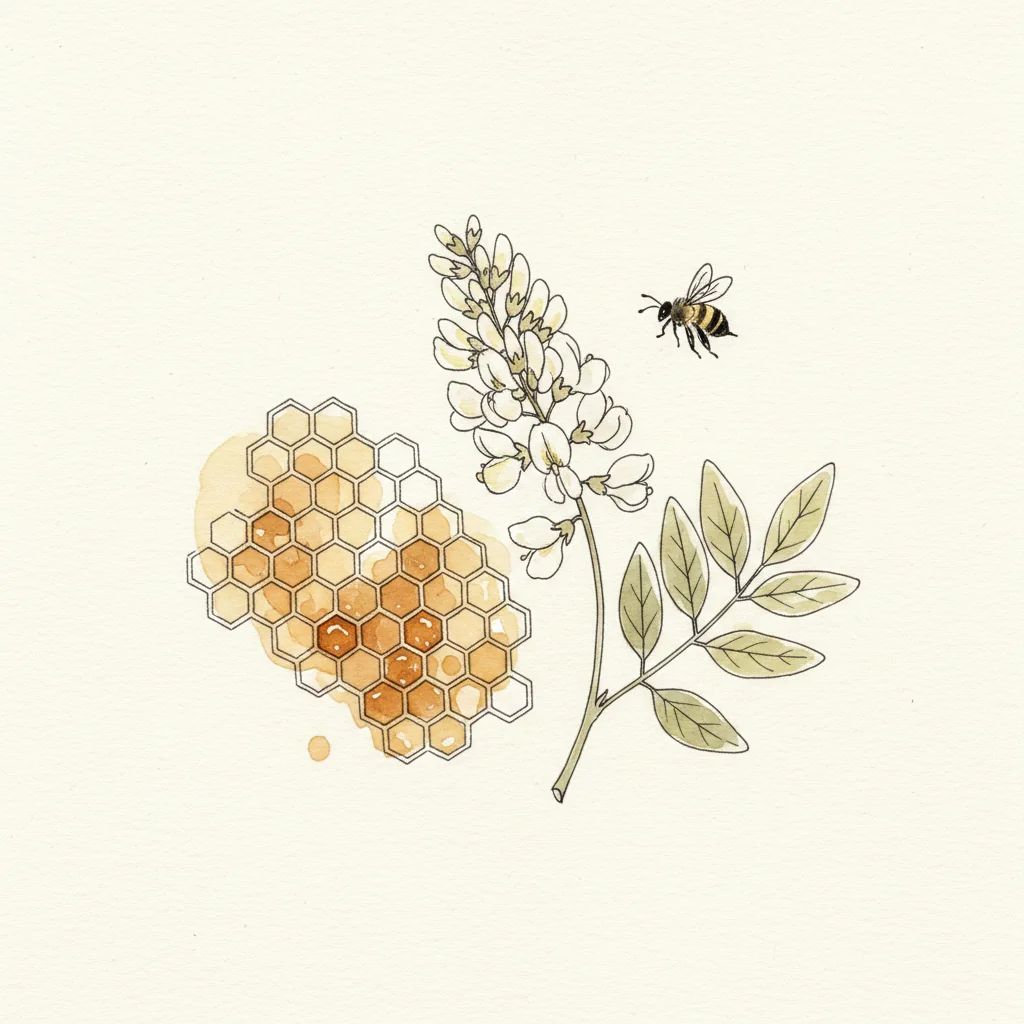
Honey · Monofloral honey
Acacia Honey
Great Hungarian Plain and the wider Carpathian Basin (also Romania, Bulgaria, Serbia), Hungary
soft floral sweetness · vanilla · clean sugar
Our verdict
Acacia for everyday sweetening; Manuka for its certified medicinal punch, not for taste.
At a glance
| Criterion | Manuka Honey (UMF) | Acacia Honey |
|---|---|---|
| Origin | New Zealand, North & South Island scrubland | Hungary & the Carpathian Basin |
| Botanical | Leptospermum scoparium | Robinia pseudoacacia (black locust) |
| Certification | UMF / MGO lab-tested (the whole point) | None |
| Intensity | 8/10 — thick, bitter, medicinal | 3/10 — soft, floral, clean |
| Main notes | Cooked honey, eucalyptus, licorice, noble bitterness | Vanilla, soft florals, clean sugar |
| Best use | Raw by the spoon, throat & immune support, warm tea | Raw drizzle, goat cheese, green tea, vinaigrettes |
| Median price | ~$38 / 250g jar (UMF 10+) | ~$16 / 450g jar |
| Value verdict | Worth it only if you want the MGO | Imbattable everyday sweetener |
When to choose Manuka Honey (UMF)
Reach for Manuka when you're buying the certificate, not the flavor. The UMF or MGO number on the jar is a real, lab-tested measure of antibacterial strength, and it's the only reason to pay three times the price of an ordinary honey. Keep a jar for the spoon-by-spoon stuff: a teaspoon raw at the first scratch of a sore throat, stirred into warm (never boiling) tea, smeared on salted-butter toast when you're run down. Here's the mechanism that decides everything: the MGO that justifies the premium breaks down above 104°F / 104°F (40°C), so the second you cook with Manuka you've paid medicinal-honey money for what is now just an expensive, slightly bitter sweetener. Spoon it onto Greek yogurt, fresh cheeses or a honey-lemon marinade for salmon — raw, cold, off the heat. Buy by grade: UMF 10+ / MGO 263+ is the honest entry point; below that you're paying for the name. And don't chase the freshest jar — the MGO climbs slowly over the first 12 to 24 months, so an older jar can be the stronger one. What Manuka is not is a flavor honey. Its dense, eucalyptus-and-licorice bitterness is an acquired taste, and on a cheese board or in a dessert a French chestnut honey gives you more character for a fifth of the price. If your goal is taste rather than throat, skip the upgrade. The one place acacia can't follow Manuka is the medicine cabinet — that's Manuka's lane, and it owns it.
When to choose Acacia Honey
Acacia takes nearly everything else. This is the honey you use when you want sweetness and nothing else: no bitterness, no strong floral signature, no fight with the dish. It pours thin and glass-clear, and thanks to its high fructose it stays runny for years and almost never crystallizes — which is exactly why it dissolves invisibly into tea, vinaigrettes and cocktails where a bolder honey would muddy things. At about $16 a 450g jar it costs a fraction of Manuka, so you can pour it freely. Four jobs it owns. First, fresh cheeses — drizzle it raw over goat cheese or burrata and it sweetens without burying the milk. Second, green and herbal teas — it sweetens the cup without dragging in eucalyptus or molasses notes. Third, breakfast — Greek yogurt and granola, warm biscuits, pancakes and waffles, where you want gloss and sweetness, not a statement. Fourth, a neutral sweetener in a vinaigrette or a sour cocktail. The rule: if you don't want to taste the honey, reach for acacia. Add it raw, off the heat — its delicate aromatics cook off, so don't waste it in a long braise or a hot bake. And know its limit: against a sharp blue cheese it simply disappears, where a chestnut or buckwheat honey would hold its ground. Acacia is the one honey that does almost no harm to your budget and almost no harm to the dish — the safe, generous default. What it can't do is heal a throat, and you shouldn't ask it to.
Where to buy?
Manuka Honey (UMF)
Links checked on
| Merchant | Price | Action |
|---|---|---|
| Amazon US | — | Amazon US |
| Sous Chef UK | — | Sous Chef UK |
Prices may vary depending on current promotions on the merchant site.
Acacia Honey
Links checked on
| Merchant | Price | Action |
|---|---|---|
| Amazon US | — | Amazon US |
| Sous Chef UK | — | Sous Chef UK |
Prices may vary depending on current promotions on the merchant site.
Frequently asked questions
- Is Manuka honey actually better than acacia?
- Not for cooking or flavor — they do different jobs. Manuka is a certified medicinal honey you buy by the MGO number; acacia is a mild everyday sweetener. For taste and value, acacia wins; for throat and immune support, Manuka.
- Can I cook with Manuka honey?
- You can, but you shouldn't if you're paying for the MGO. The active compound breaks down above 104°F / 104°F (40°C), so cooking turns a $38 jar into an ordinary bitter sweetener. Use it raw.
- Which is better value?
- Acacia, easily, for everyday use — about $16 a jar versus $38 for entry-grade Manuka. Manuka is only worth its premium if you specifically want the lab-certified MGO.
- Does either one crystallize?
- Acacia almost never does, thanks to its high fructose. Manuka can thicken and set over time; a brief warm-water bath under 104°F restores it without harming the MGO.
The best pairings
With Manuka Honey (UMF)
With Acacia Honey
The producers
With Manuka Honey (UMF)
With Acacia Honey
Other comparisons
With Manuka Honey (UMF)
Comparison prepared according to our methodology. Sponsored purchase links — see our affiliations.